Posts

Japanese Army 1st Raiding Group Dog Tags (Paratrooper and Ancillary)
Image
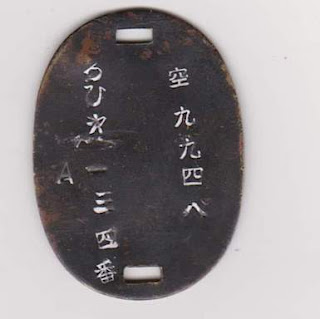
9  dog tags identified. At present  only 3 rd  Air Raiding Regiment tags are available, no indication on how the other three air raiding and two glider regiment tags were stamped  ラ ン   ‘Ran’ (katakana  ラ  ra  ノ no) appears to crown code numbers for non-air units.  Eric Queen suggested, and it makes sense, code kanji  鸞   ‘Ran’ (Phoenix) was perhaps avoided as being illegible when stamped onto the metal tags. Note : 'Air Raiding Regiment' was the Japanese military's term for  paratrooper regiment.    3 rd  Air Raiding Regiment  空   9948 :  空   tags stamped “Sora”  above unit’s code number. Company Designations (hiragana arranged alphabetically, their actual order is unknown to me at present): ろひ  Rohi – 1 tag, paratrooper #134  ろふ  Rofu – 2 tags, paratroopers #40 and #45  ろほ  Roho - 2 tags, paratroopers #19 and #57 ろ み  Romi – 1 tag, paratroopers, # 38  ...

Army Shipping Units:

Image
Army Sea Transport, Depot and Hospital Units : The Japanese Army’s Shipping Command was a separate arm of service dedicated to transporting troops and supplies by sea. It carried out most of the early war amphibious landings while the navy provided armed escorts. Later in the war navy destroyers and submarines were often substitutes for the army's civilian style transport ships, which proved overly vulnerable to Allied submarines, fighters and bombers.  Under command of General Shipping Command, located in Ujina, Japan, the Transport Headquarters (shown in some detail below) provided the necessary network to facilitate movement of ships throughout Japan’s wartime empire. Dockside, Anchorage Headquarters units organized the loading and unloading of ships, under them Sea Duty Units provided stevedores for the operation.  Legend : 1. Parenthesis (123) are the number of individuals in a unit. 2.  DN   • Distributed Numbers; blocks of numbers assigned to the various unit ...

Muroran Guard Unit Service Record Booklet:

Image
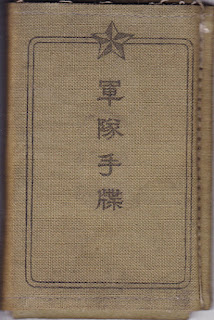
Sometimes a small poignant glimmer connected to larger events from the past appears. In this case the Army Service Record Booklet of Mr. Hasebe of Sapporo makes him, by implication, a participant in an historic, if terrifying, event that occurred during the closing days of World War 2.    Pvt. 2 nd  Class Hasebe became active on June 25, 1945 in the  8 th  Independent Guard Unit, part of the Muroran Guard Unit, providing security to the  Muroran Iron and Steel Works  on Hokkaido. Less than a month later his unit was subjected to an intense 300 to 400 shell US naval bombardment. See quote and link below:  World War II Database ).  The 8 th  Independent Guard Unit was demobilized Sept 17, 1945 (Japan demobilization report).    Personal Information : Jurisdiction:  “ Tatsu ”  達 8150 (code for: 5 th  Area Army HQ) Unit Number:  “ Tatsu ”  達 12638 Butai (code for: 8 th  Independent Guard Unit)  Mil...

Imperial Japanese Army Field Post Offices in Southern Areas

Image
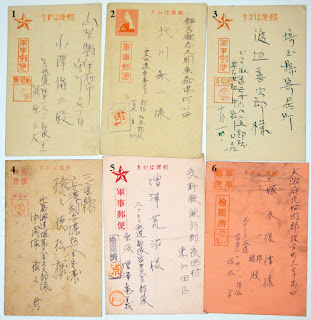
Japanese army  field post office units  were responsible for handling all military mail and in addition the postal system functioned as a bank for deployed soldiers. Postal savings account booklets were used to maintain a record of deposits and withdrawals. The mail service was free for soldiers. As a rule, officers were allowed to send letters but enlisted men limited to postcards. Censorship rules were strictly enforced lest sensitive information fall into unfriendly hands.  Organization : This example shows authorized strengths for the  13 th  Field Post Office Unit  (presumably most field post office units were similar): Headquarters and Central Post Office: 55 soldiers and 10 civilian employees 1 st  to 4 th  Field Post Office Companies: 5 soldiers and 5 civilian employees each Total: 255 soldiers and 30 civilian employees. Note : All branch offices share the code name and number of the field post office unit they belong u...